Categories
Tag: travel


Categories
Always Moving


For most of my life, saying goodbye has been emotional. It’s filled with wants and needs wrapped in a dramatic parting, or so my heart tells me. And this trip has been full of goodbyes: to friends, to family, to home, new friends and places I’m just beginning to understand. This is one.
At the same time, I’ve never been able to stop moving. More than two months in one place and my feet start to itch.
Island life is calling, and the smoke is hard to take. So, it’s two trains, a bus and a ferry to a new place with fresh air and long sandy beaches.

Categories
Ganesh Artist’s Colony
Home to the world’s largest wooden Ganesh statue, weighing five tons and carved from a single tree, this artist’s colony is funded by a wealthy patron who sees it as his legacy. The main building is built with thick wooden planks covered top-to-bottom with detailed painted carvings. It’s a beautiful, peaceful, inspiring place.


Categories
Devotion


Categories
The Rhythms of Chiang Mai

From the scooter-bustle of Bali, daytime Chiang Mai contrasts as a place of delivery trucks, local shops, temples, and nomads with heads down in their work. And then in the evening, when the cool air settles down from Suthep and the smoke from nearby rice-patty fires fades, the patio lights come on and the parties begin.

Like Canggu, Chiang Mai opened to me with a string of hangouts and events to meet fellow nomads. I’m staying at In The City, a cozy and helpful co-working space and hostel. It’s a great jumping-off point for getting to know the city.

Chiang Mai has been at the top of my must-visit nomad cities for a long time—not because I’ve had a personal hankering for its temple-lined old city, but because everyone I’ve come across who’s visited the place is effusive about it. Consistently at the top of NomadList’s rankings, I can see why. It’s friendly, fun, easy to get around and meet people, walkable and very affordable. There’s a much higher percentage of long-termers here in Thailand, people who have settled and made Chiang Mai home. It’s incredibly cheap to live here (apartment & coworking space for $150/month? Check!) with many events, hikes, and places to visit.
I’ve only been here a week but I’m loving it so far. A great vibe, great people and a productive space for me.


Tucked away in a quiet side street, behind an unassuming café, dozens—and on busy days, more than a hundred—fellow nomads crunch away on their laptops. Some are software developers. Some are marketers. Some are cryptocurrency bros. Many are starting a new business.
For most it’s a lifestyle choice. Life on the road is cheaper, with more freedom and a culture developed to the point that many communities surround newcomers to make the transition easy.

It’s also a sign of something else. It’s empowerment—for a specific kind of individual. It’s an extension of the “do what you love” movement, enabled by the privilege of mobility, education and digital economies.
The upsides are great. Having a group of fellow travelers who are open, interested to learn, ready for connection and already in a place of growth makes for a potent milieu. There’s something here, an energy and a possibility that’s just at the front edges of being explored. But, like many things being primarily explored by people like myself who come from Western privilege and education, I’m cautious and a little skeptical.
There’s a dark-grey underbelly. Local culture is largely ignored. Perhaps it’s a little more healthy than pure consumerist tourism, but still: when hundreds of by-local-standards wealthy remote workers descend on a place, it shifts the cultural dynamics. There’s also a very strong bro culture amongst many men that I find challenging (though there are many awake and aware men as well). And the largest mostly-undiscussed downside: living life as a nomad leaves traditional community structures in tatters. Human mobility requires a completely different approach to lasting relationships, something I’m curious to explore and learn more about as I continue my trip.
What’s here is real and interesting as a cultural phenomenon. Can it be extrapolated beyond the privileged, largely Western and white group who are taking advantage of it now? Philosophically it relates to many things—migration, travel, cultural interaction, privilege, exchange, the value of work and workers, how we calculate wealth. It’s definitely something new, definitely different, and definitely just the beginning.

Categories
Bali Vibes

It’s a bit of a cliche, I know… but despite the hordes of partiers who end up in nearby towns, Bali—specifically Canggu—is a great place to start a long trip. It’s cheap, accessible and there’s a great digital nomad community centred around Dojo Coworking. It’s been a great spot to get into the rhythms of nomadic travel and meet some fellow work-while-wandering friends.


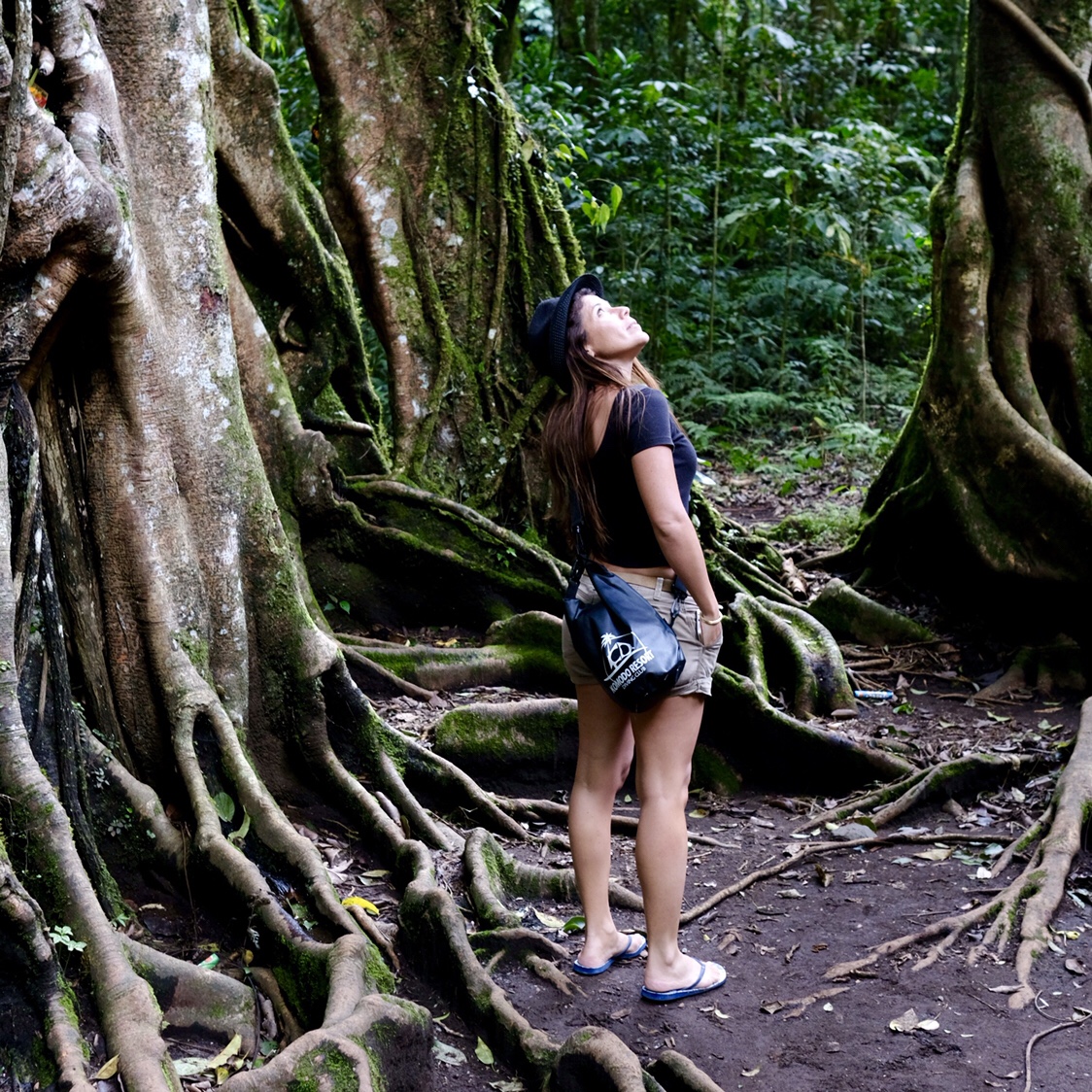

The people are the best part. My first night in Canggu a fellow nomad took a few of us new arrivals around to his favourite hotspots. It was a great kickstart to meet some friends and find some regular haunts. As I’ve seen before in my travels, if on your first night in a new place someone local invites you out, it’s a good sign. Canggu is no exception. A small group of us from that first night ended up forming a core that would travel to nearby adventures on the weekends, grab meals together and generally commiserate.

Surprisingly for me, many of the people trying out the nomad lifestyle are in a similar life stage—30’s, had some success, trying something new. A beautifully large proportion of them are women. So far I’m the only full-time filmmaker but hopefully that’s just a matter of time.
The downside to Canggu is that it’s very, very touristy, and the prices & culture reflect the mostly-foreign population. So while it’s a great place to get my feet wet as a traveler it’s not a leap as far as I’d like. It’s more a tropical party-town Portland than a cultural excursion. So we’ll see where I’ll end up next…
One upside: Canggu is a convenient place to practice my scootering, in particularly my Darth Helmet impressions.

Categories
New Beginnings
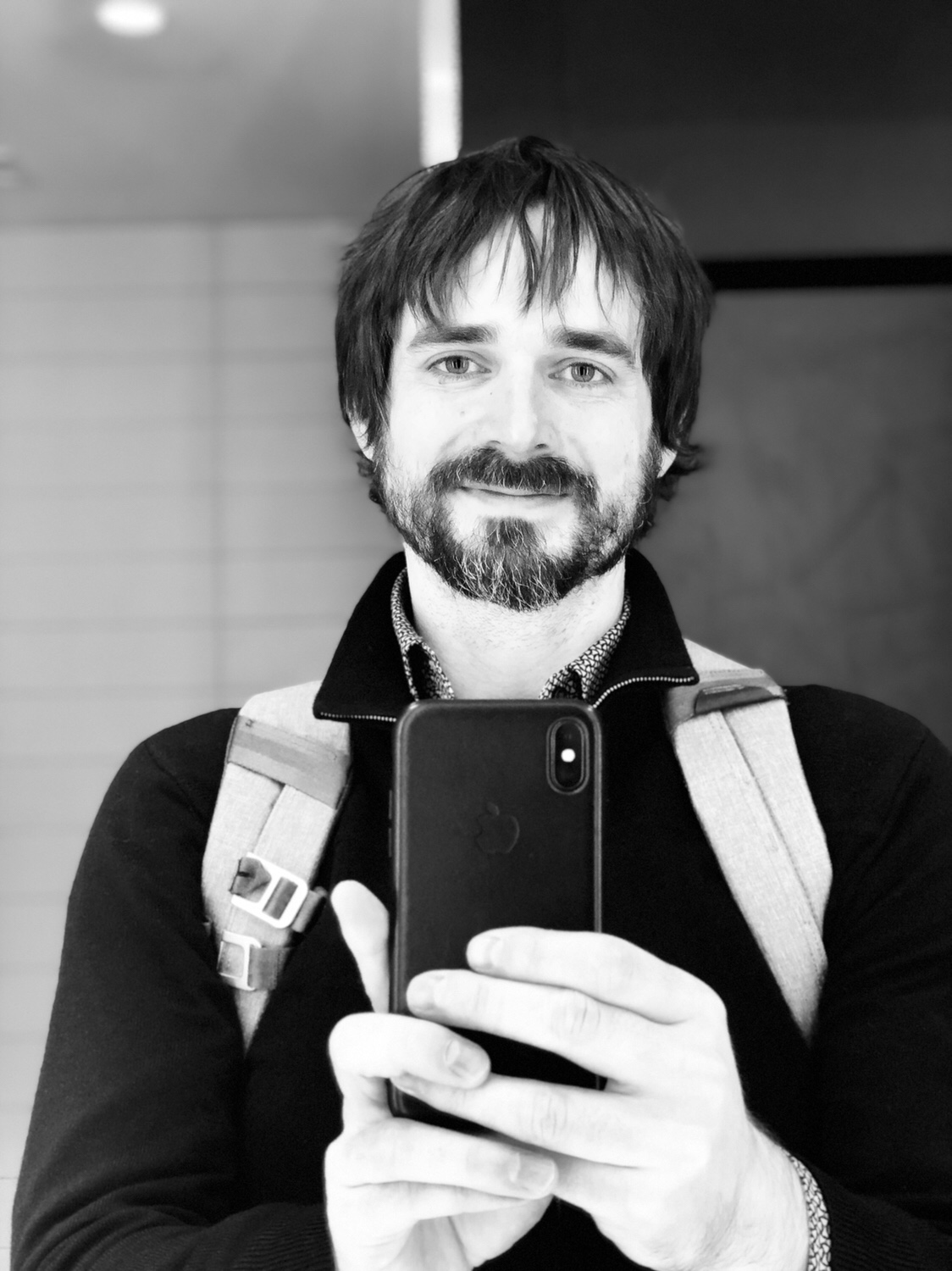
There’s so much that can be wrapped up in a single photo. For me, this image represents the end of many things and the start of something new; something I’ve been thinking of and longing after for most of my adult life.
Today I begin life as a nomad. I’ve sold all my belongings, packed a few momentos into boxes with gracious friends and family, and sized my physical entourage to fit the dimensions of two small backpacks. In every way I’ve downsized, outsourced, automated and rethought to bring my life to its most minimal essence: me and a few things, on the road.
I expect to spend at least a year traveling. My goal is to travel westward, starting in Indonesia and completing a circumnavigation back to Canada in time for Christmas. And after that… we’ll see. I’ve quietly updated this site to be a home for stories and photos from my travels along with news on my latest projects. I will edit my most recent film while I travel as well as starting projects as I go, though I leave the possibilities and opportunities open for what comes next.
Glad to have you here, and excited to see where this goes!

As is my way, I began close to my new home base, wandering in slow concentric circles. I like to be on the edge of the familiar—as far out as I can, just as far as that last thread of connection will take me. One foot knows the way home. The other itches for un-trod ground.
Slowly, as the initial glut of colour and sound begins to receed, my filming becomes more conscious. More paced. I start waiting. Listening.
I’m here in search of something. What, exactly, I’m in the process of unraveling. I’ve brought my camera, my most prized possession—not for its metal and pixels, but for its process. When I don’t understand my world, the camera is where I turn to make sense of things. The simple act of composition helps me to slow down and listen. The weight of the camera as a physical and psychological presence forces me to be attentive to the rhythms of a place, to its heartbeat. As I do, things start to come into focus.
This time is a bit different. I’m feeling unsettled for some reason. Every other trip like this, I’ve had some kind of guide. It could be a project for which I’m filming, a local fixer, a common cultural base or something as simple as a Lonely Planet book. These guides create a safe zone, a picture frame within which the rest of the action can take place. Here in Nepal I have no guide. The action can happen in any direction, across a culture I don’t yet understand. And that’s already played itself out.

The karaoke bars and blaring horns are the first tip. I unintentionally landed in the midst of a tourist ghetto to start my trip. Thamel is a small corner of Kathmandu, and admittedly it’s more a reflection of western consumption than of anything Nepali. Hospitality and friendliness still shine through, but the place has an ugly social veneer, westerners rabidly feeding at the trough of exotic trinkets. Manipulative and degrading human behaviour are on display in locals and visitors alike.
The more serious discovery is that I’m afraid. I’ve put myself so far to the edge of my abilities that I’m overwhelmed, and I’m using my camera to cope. Instead of using it to create something beautiful, I’ve been using it as a shield against the powerful emotions bubbling up in the chaos. I’m observing without the deeper human connection that I’m truly here to participate in.
Filming is a solitary experience. That’s what drew me to it. The camera is a way to process complex experiences into a series of micro-moments. I can be surrounded by a crowd of thousands, yet behind the camera I have a quiet corner all to myself. I’m an observer rather than a participant. And on this trip it means I’m on a different journey than many of the travellers I’m bumping into. We chat in coffee shops and share stories over dinner, and then go our separate ways. My slow, observational pace means shared itineraries are incompatible. Travelling solo, with my camera, has led to a certain kind of isolation that is colouring my experience.
It makes me wonder about the wisdom of bringing my camera. The slow meditative process is wonderful for enabling absorption of the deeper elements of what I’m seeing. Yet by its very presence it’s changing my experience. A twist in my stomach makes me wonder if I’m missing what I would otherwise see if the camera were not here.

At the same time it’s unlocked doors. Outside the dusty corners of Thamel, people are genuinely curious and often pleased to have the lens turned in their direction. It creates a conversation and a friendly exchange, one of the things that I find sacred about filmmaking. The camera opens doors that are otherwise closed to outsiders.
And it’s given me something to share back with you. The sonic landscape of the place, the visual texture, the emotional tapestry is impossible to communicate using only the fragile lattice of language. Moving images can in a small way transport you to see with not only your eyes but your heart what I’m seeing as I travel.
I came to Nepal wanting to listen. Within the first few days, not only what I’m listening for, but my way of listening is in question. It’s is a place that changes you, people say. I think that’s at least in part because people come here to be changed. There’s something to it, though. There’s a feeling to this place that’s both ancient and friendly that interrupts my expectations. Inside the stone walls and bright colours is a heartbeat, something special and unique. And I want to keep listening.
I’m continuing to publish thoughts from Nepal while I’m back in Vancouver. Thanks for everyone’s concern re: the recent trekking tragedy in the Annapurna region. My thoughts and best wishes go out to those who’ve been affected.
Categories
Ascent To Annapurna

About the time I lost my way to Chhomrong. About the family that stops for tea and poetry, three generations reliving the grandfather’s journey. About the change the altitude & mountains force on those who climb it. For now I’ll let the pictures say what they can about my trek into the Annapurna Sanctuary.
Kathmandu


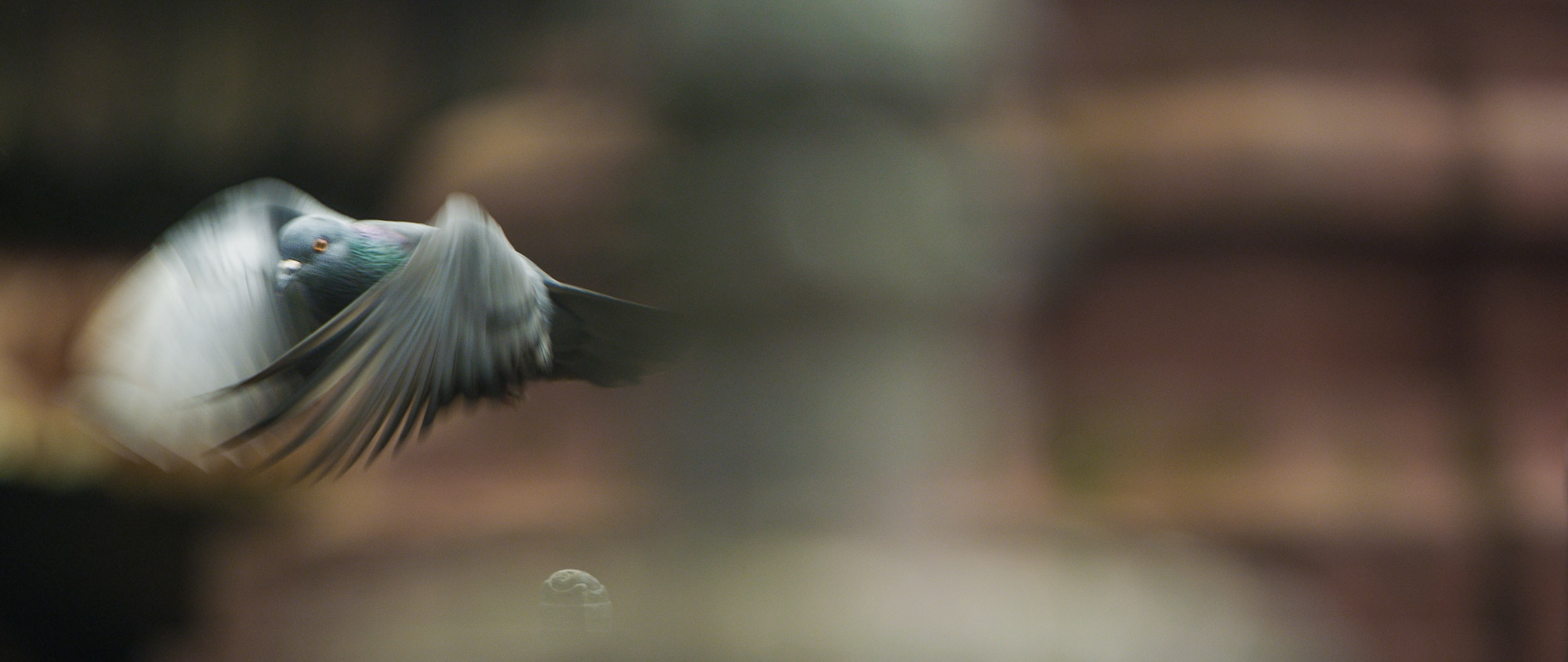


The first few days were spent in Kathmandu. It’s a smoky, dusty, smelly group of old cities, a place growing in on itself and over its own history. It’s a fascinating mish-mash of culture, tourism, poverty and growth.
The Ascent Begins
I was glad to get up into the mountains. Life is very different up here. Everything to sustain life is carried by another living thing. The trek is hard, thousands of metres of vertical—over 6,800m total once you count the ups and downs. It’s one of the most physically difficult things I’ve ever accomplished, in no small part because of the heavy camera I carried to take these images.

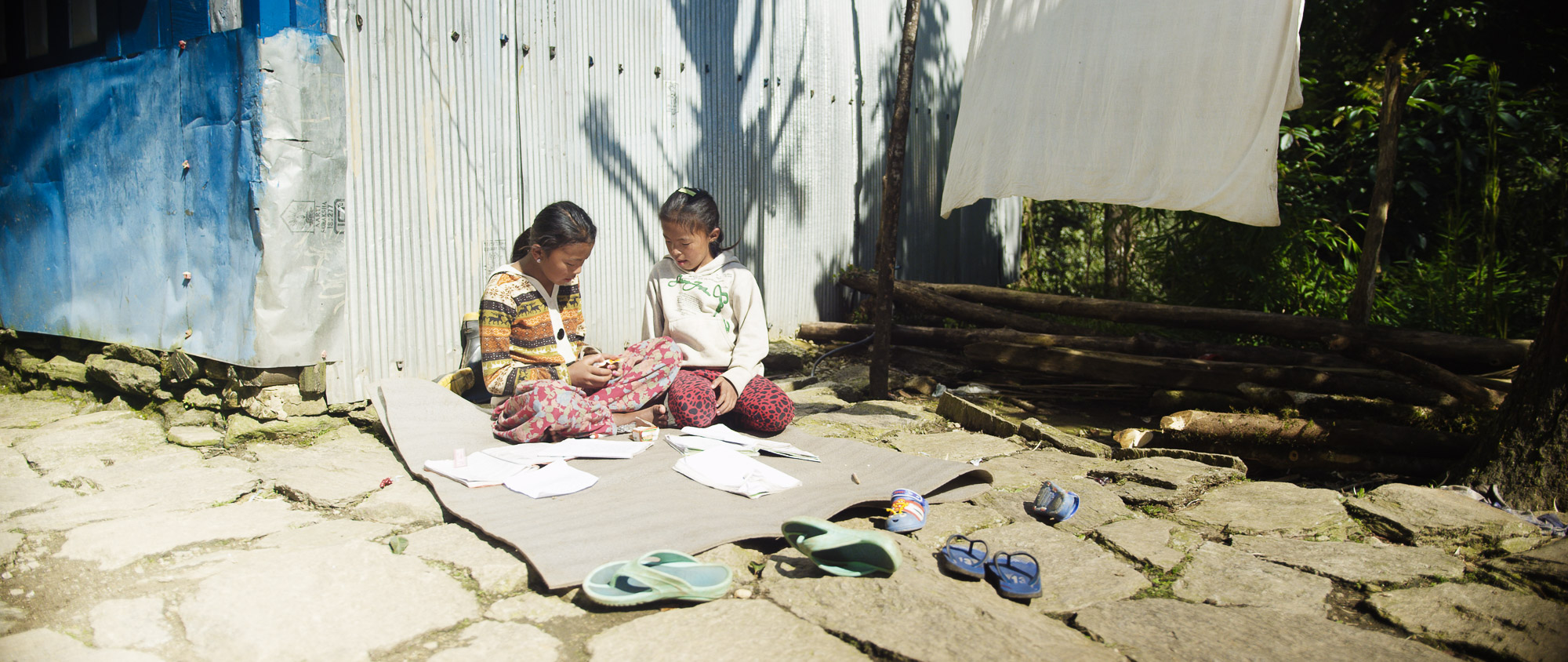


Into the Green


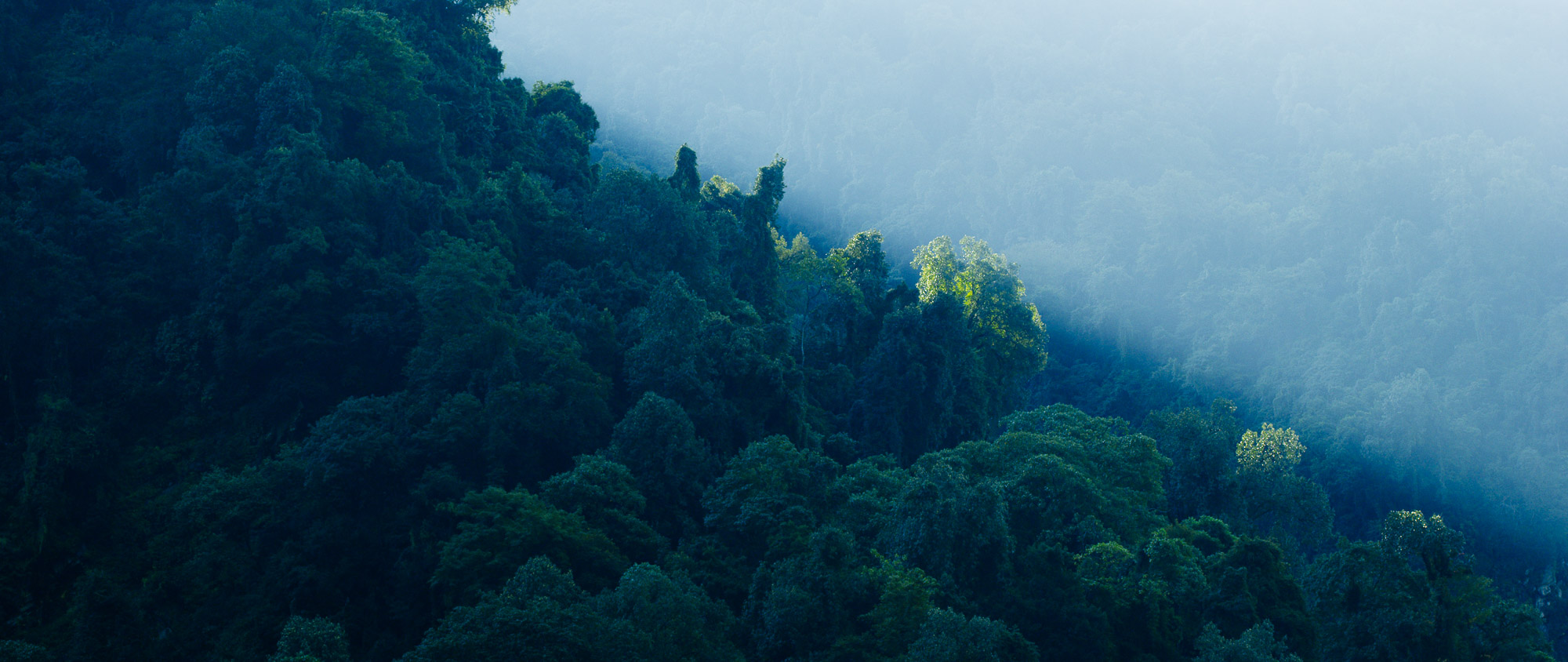
The lower reaches of the trek are all green, verdant jungle. Rhododendron gives way to bamboo which fades into other shades of green. Strange birds and insects chirp alongside the constant rush of the Modi Khola. Everywhere is water, the trail snaking its way through and around its etchings in the rock.
Climbing into Clouds
The alpine only makes its appearance above 3500 metres, the jungle clinging high to the valley walls. As you ascend, green slowly disappears into horizons of blue, black and orange.


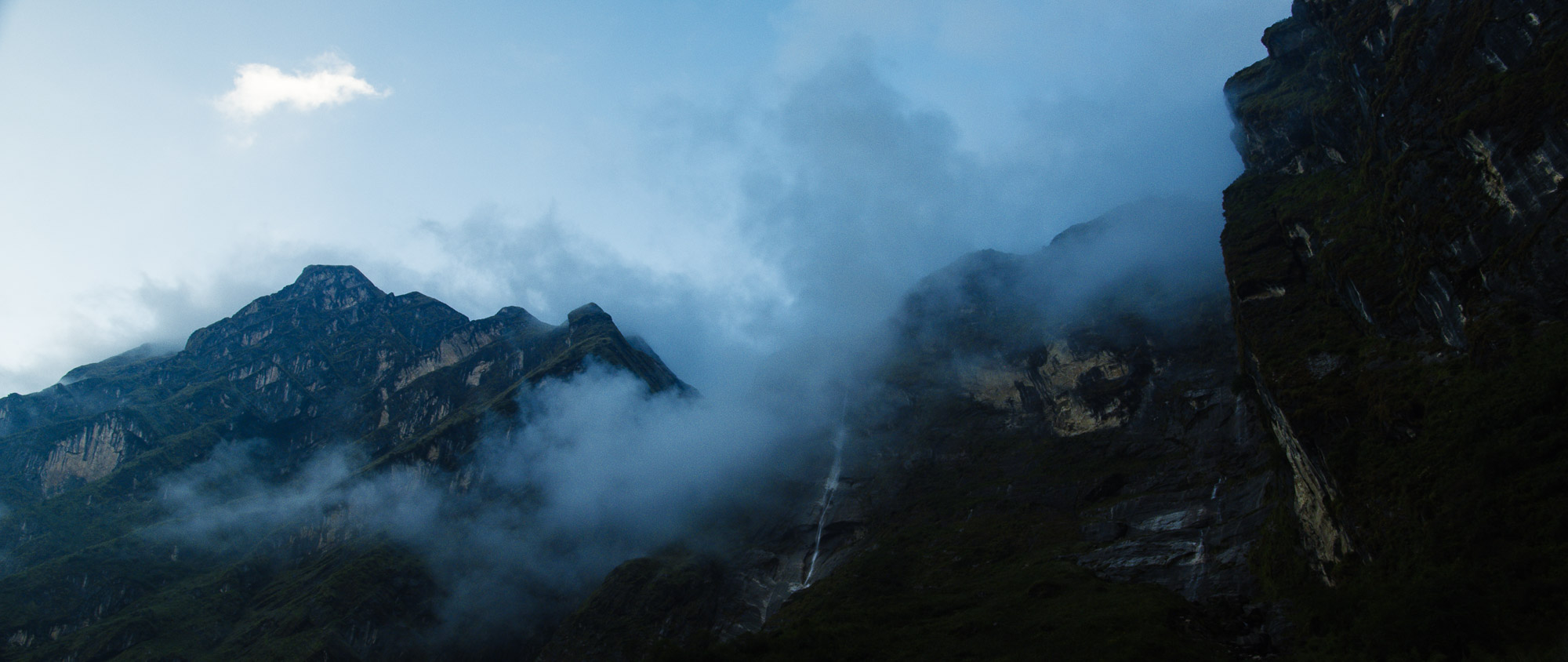
Turning the Corner
And then the mountains appear. Approaching Machhapuchhre Base Camp (the last stop before the top), you turn a corner into the final ascent to ABC.

The Final Climb
My last climb was late in the day, shrouded in fog through the alpine valley that leads up to the Camp. I could see nothing of what was about to open up around me. I went for a cold sleep and awoke for sunrise, and the result was truly breathtaking.


Small in a Big World
Getting up to Annapurna Base Camp is a kind of pilgrimage. It’s long slog through jungle and rough trails. For me, doubly so: I was solo with a heavy pack, alone on the trail without a guide, porter or familiar friends. Arriving at the top is hard to express. In everyone it induces a kind of silent awe, sitting amongst a sanctuary that reminds us of our smallness.


Friends Along the Way


One of the surprising highlights for me was just how many friends I made on the trek. I’m a quiet person, more likely to observe at first than to join in. This experience was different. After several hours of focused concentration on the trail, the downtime in the lodges became openly social, meeting new friends and sharing stories. I met some fascinating people along the way, some of whose stories I hope to tell.
Blue and Gold
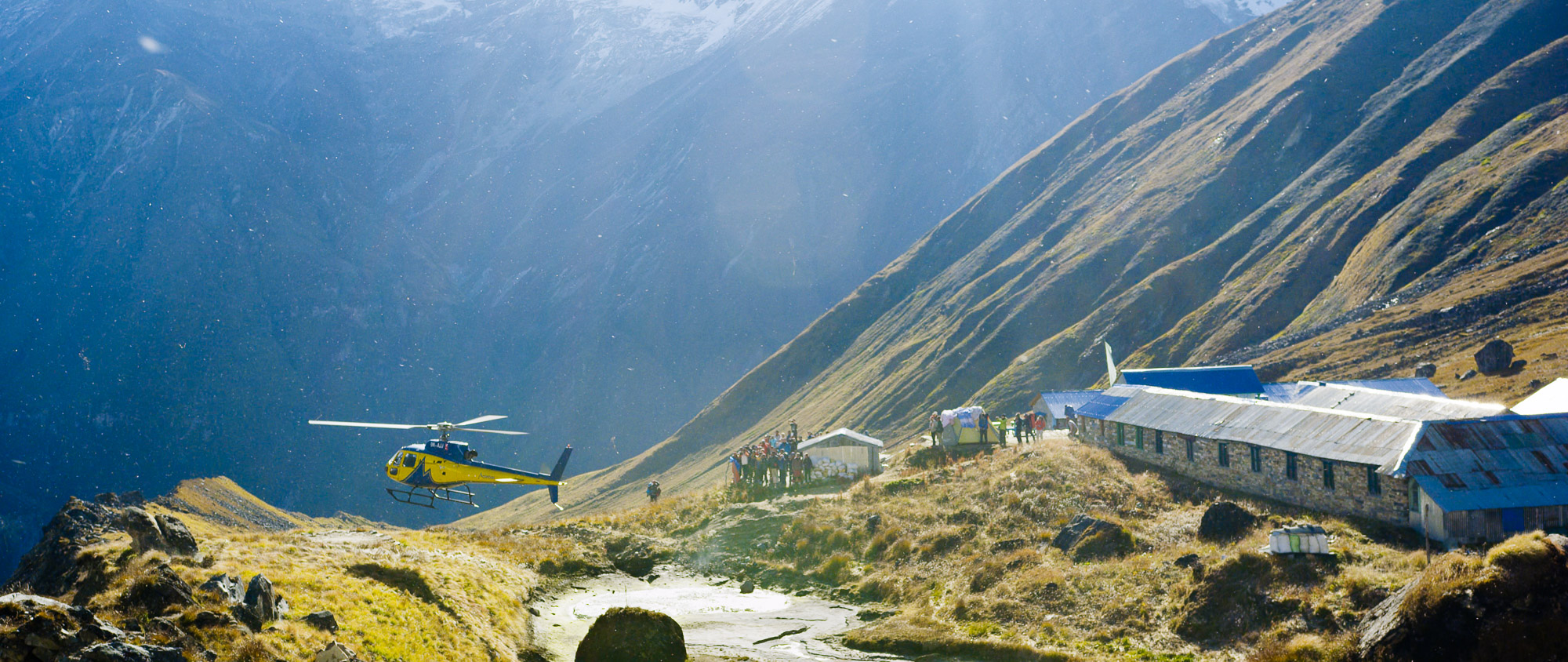
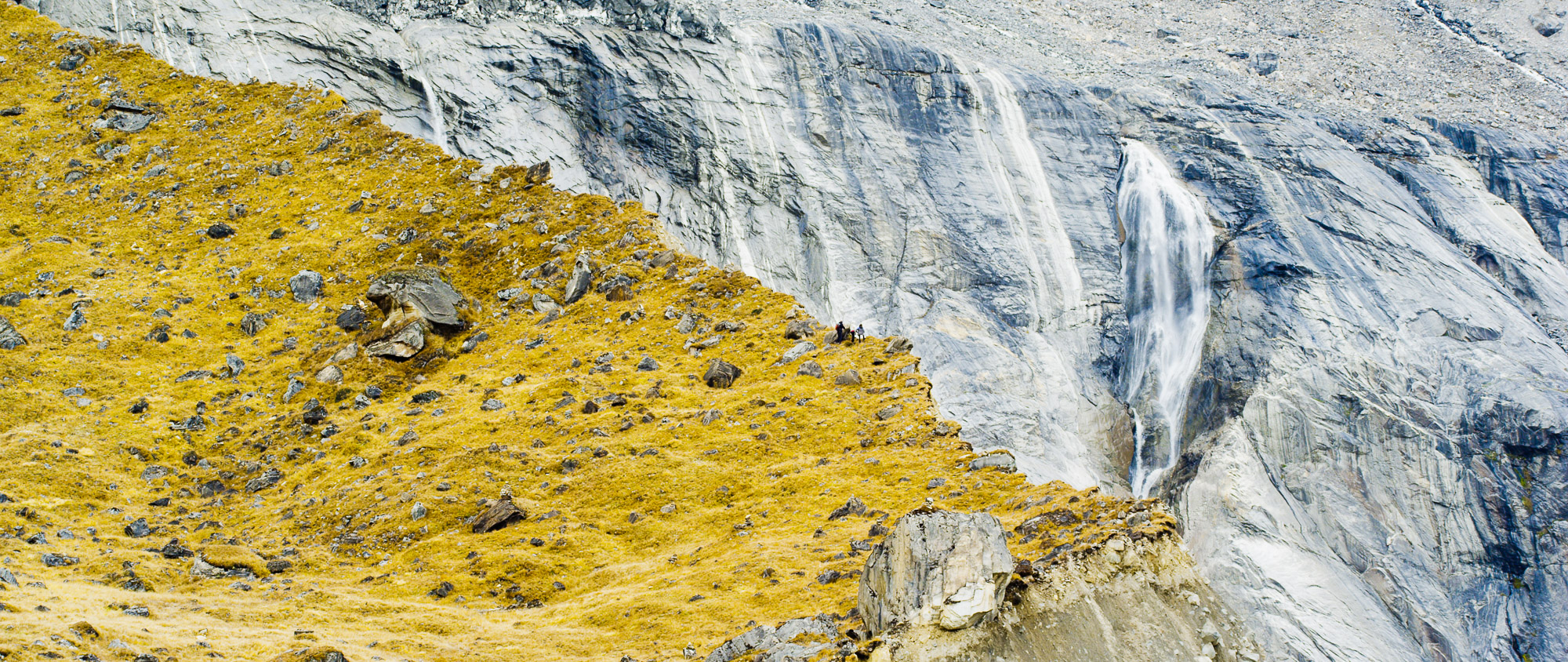
The last day before the descent was spent wandering up to the glacier and taking in the immensity and scale of the mountain peaks that surround us. We came up 4000m, and yet the peaks around stretch twice that height. They feel close enough to touch. When a helicopter comes to rescue someone from altitude sickness, the scale of the place becomes apparent as he flies away for several minutes without reaching the mountain walls.

Descent
The place is magnificent and attractive in a mysterious and quiet way. I don’t want to leave. Eventually the body has to give into the punishment of the same steps in reverse, and I step back into the green and away from the mountaintops.
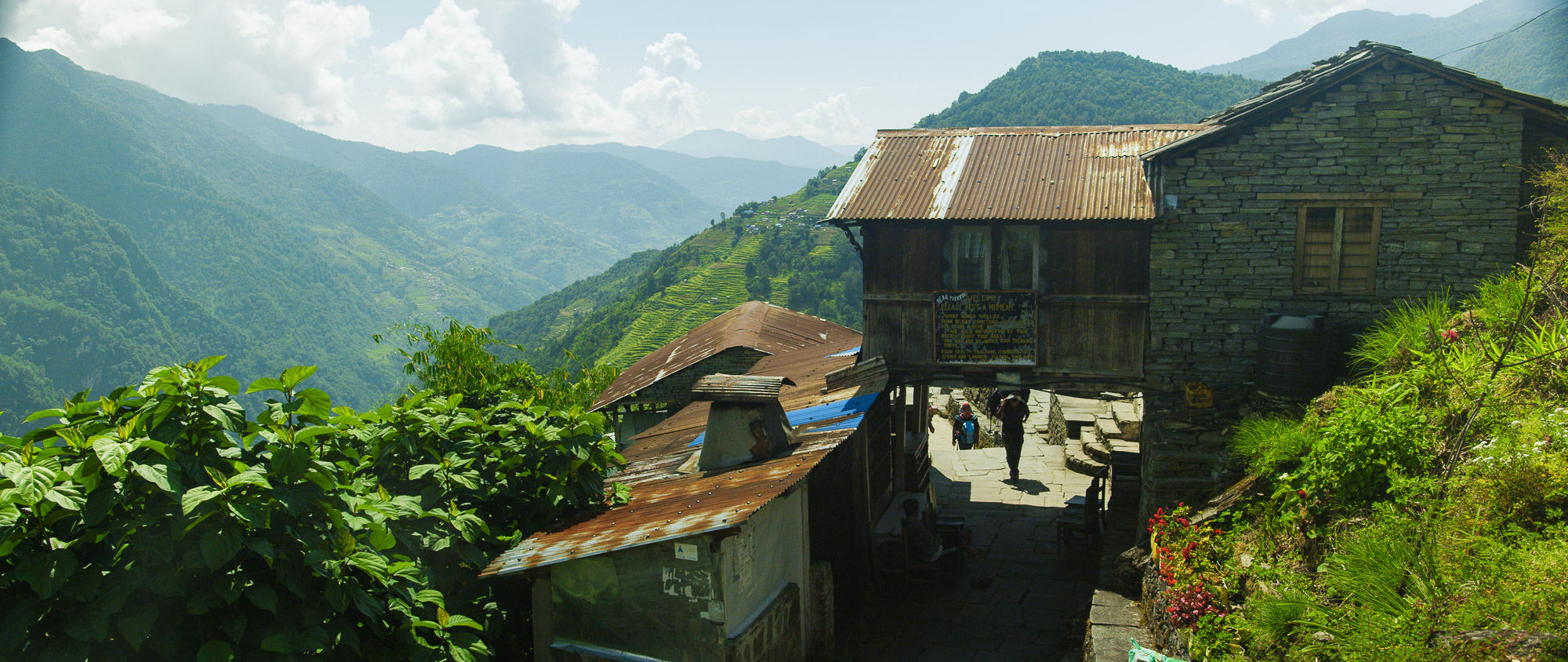

The Last Stop
The final night for many is in Jhinu, the hotsprings below Chhomrong. It’s the first chance for physical relaxation after a gruelling descent. Trekkers, porters, guides and hosts alike all join in the post-accomplishment party. This particular dance party broke out at dinner and continued late into the night.
